Label: logging

Logging is the process of recording information about how a program or system operates. Applications write log messages to help developers monitor behavior, detect errors, and diagnose problems. Logs may contain status messages, warnings, debug information, performance metrics, or security events. Modern software often supports multiple log levels such as INFO, WARNING, ERROR, and DEBUG. Log data can be written to files, consoles, system services, or remote servers. Structured log output formats like JSON are commonly used for automated analysis and monitoring. Efficient logging is important because excessive overhead can reduce application performance. Logging plays a critical role in debugging, observability, security analysis, and production support.

Understanding logging is essential for software development, troubleshooting, and system monitoring.

Log Source Profiling: Which Log Statement Is Responsible?
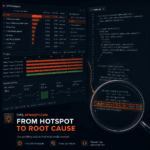
How log source profiling traces CPU and file I/O back to individual C and C++ call sites without disabling production diagnostics Log source profiling starts where a normal CPU profiler stops. A system profiler can tell you that a logging thread is consuming CPU and show write(), a file-backend worker, queue synchronization, memory copies, and

Migrating from glog to logme: LOG, CHECK, PLOG, and VLOG in a New Logging Model

Migrating from glog to logme does not have to start with a full rewrite of every logging call. In large C++ projects, that is usually the wrong first step. Logging statements are spread across the codebase, and they often sit next to checks, conditions, diagnostic messages, CHECK, PLOG, VLOG, and debug-only calls. Replacing everything at

logme channels are more than named loggers

At first, logme channels can look like ordinary logger names. You may have channels such as HTTP, DB, TLS, or UI. At first glance, each log call seems to add nothing more than the corresponding label. A channel is a full runtime object. It decides whether a record is accepted, how it is formatted. Where

C++ Logging Macros: Why Are They So Complicated?

When developers first look at a modern C++ logging library, one thing often surprises them: the number of macros. At first glance, this raises an obvious question: why are there so many of them? Wouldn’t one clean Log() function be enough? Yet libraries such as logme provide dozens of variants, including LogmeI, LogmeW, LogmePV, fLogmeD,